Showing posts with label beijing. Show all posts

Thursday, August 28, 2008

This week's column: What Happens In Beijing...

Here's this week's column in the Weekly. Forgive the headline; I think my editors were tweaking me. (See the WHHSH discussion near the end of the piece...)


What Happens in Beijing...

How a local newspaper squandered a terrific opportunity

By STEVE FRIESS

Back when I lived in and covered Beijing earlier this decade, I used to have this odd little game I played with my friends.

My core group included women from Des Moines and Brisbane, Australia, and guys from Seattle, Manchester, United Kingdom, and Victoria, British Columbia. From time to time in our travels across the country, we'd chat up native Chinese, usually people who spoke some English, on a train or at a bar or at a restaurant. Two of my friends were becoming fluent in Mandarin, so they were at that stage when they would try out their language skills.

But here was the game: We'd meet these folks, and we'd introduce ourselves. And I would always go last. My friends would each introduce themselves and state their city or nation of origin.

And then it would be my turn, and I'd say "Las Vegas," and the reaction would be instantaneous. Eyes would brighten at those syllables, the interest would always turn my way, and almost without fail somebody would make a motion as if to pull the lever on an invisible slot machine.

Which is a long way of saying that the Review-Journal sent doofus sportswriter Ed Graney to China, and, in the process of providing the idiot's guide to Chinese customs and tourist destinations and some serviceable coverage of the sporting events occurring there, he missed the best story that was waiting for him.

I have to believe it was right in front of him. There was never a time when I was over there that I said "Vegas"—to anyone, including people who didn't speak a word of English—and didn't elicit a reaction. Surely he discovered this. The only indication we have, though, is a silly blog post about what some Australians, who were also other journalists, thought of Las Vegas, and a short bit about encountering a pair of Chinese interns whose wisest observation of our city was, "One dollar, touch butt."

So I decided to do the assignment for ol' Ed.

Read the rest HERE

Sunday, August 10, 2008

Please, Ed, Make It Stop!

Apparently, I was wrong in my last post when I assumed that the Review-Journal's sports columnist Ed Graney would move on to start covering what he understands -- the sports of the Olympics -- once competitions got underway. Evidently, despite the fact that Michael Phelps broke his own world record, an American tourist was killed and the U.S. president seemed to get hot and probably completely offended half of his anti-sex religious-kook base back home by frolicking with Team USA's 7/8-naked women's beach volleyball players, Our Man In China was busy writing the idiot's guide to Beijing tourist attractions.

Today's dispatch included a predictable piece on the awesomeness of the Forbidden City complete with a few minor inaccuracies and a reference to "The Last Emperor" as well as, this being a sports writer and all, an obligatory Tiger Woods analogy. You know you're in trouble when the piece starts with "Maybe you saw the movie. Maybe you didn't." Well, gee, Ed. That's kind of what "maybe" means. Thanks for covering all the bases.

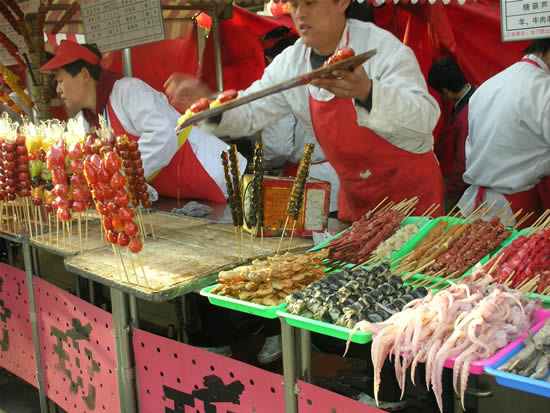
But what's worse is the sidebar on weird Chinese food offerings on a stick at Wangfujing Night Market. This offered a particularly interesting contrast because there's Ed rambling about trying the scorpions-on-a-stick and taking note of other oddities and then in the R-J's sports section there's a piece by humorist Dave Barry that mocks all the journalists at the same site doing exactly that and thinking they're so clever. Except, of course, Barry was funny and original and Ed was a cheap, cliche-soaked imitation. Barry also noticed, as Ed did not, that the Chinese weren't eating these crazy things; Wangfujing is an odd tourist trap that profits off of the West's stupidest impressions of the Chinese by playing into it. "I would not be surprised to learn that the Chinese word for scorpion is 'TV reporter food,' " Barry wrote perceptively.

Also, Barry didn't throw in a gratuitous line about the Chinese eating dog parts like Ed did because, I suspect, Barry knows this is an increasingly rare concept, as an essayist in the NY Times noted recently. In all my travels and coverage in China, from sleeping on the floor of an AIDS victim's home in Henan Province to sleeping in a yurt in the remote northwest mountains of Xinjiang, I only ever saw one instance where anyone used dog meat for food. It was in a punishingly poor area near Guilin in south-central China where the desperation was beyond anything I'd ever seen. They eat anything they can in these places and you would, too. But in a modern metropolis like Beijing? Uh, no.

Our Man In China also cracked me up in his blog by going on a little babble about how foreign newspapers were burying the news of the dead American tourist. Uh, hello? Ed didn't write a word about it in today's paper, either, and the R-J ran a long wire story from the Olympics that took well into the jump to get to this news. It appears on page 10A, about 14 paragraphs into a story that is largely about Bush's exciting day. Ed chides the China Daily, where I worked and mocked mercilessly in Editor & Publisher years ago, for putting it on page 5. That's more prominent than the R-J!

So here's my prediction for the coming week. Our Man In China will go to the Great Wall, declare it truly impressive and take note of the T-shirt vendors there as a contradiction of capitalism in a Communist nation. He'll go to the Summer Palace and marvel at the big, expensive marble boat that can't float the Empress Dowager bankrupted the Navy to build, making some comparison to some U.S. pro sports team's failure to win despite spending millions on talent. Some Chinese person will ask to take his photo and he'll write with bemusement about the experience. He'll probably get approached by a Chinese hooker who acts demure and wants to "practice her English" and he'll think, "Wow, this is my Front Page Lead tomorrow!"

Or maybe Ed will focus on the sports themselves. One can only hope.

Bookmark this

If you love political cartoons and you're into the Olympics, I strongly suggest you bookmark this link from Daryl Cagle's Professional Cartoonists Index. It's a great time-waster. Some are biting, some are predictable, some are artistic and some, like this one below from the Hong Kong-based South China Morning Post, are all of the above.

Saturday, August 9, 2008

Why I'm Not In China


If you can't quite see behind the glare, that was the odometer reading on my car last night when I got home to watch the Opening Ceremonies for the Beijing Olympics. 88088. On 8-8-8. I am not religious and I am not usually superstitious except for one small illogical fondness I've always had for the number 16. I was born on one and a zillion other things have coincided with the number. And all those 8s that add up to all those 16s...well... whatever.

I've been quiet on this blog for the past couple of days in part because I'm a bit depressed. As I wrote recently, in what seems like another life I lived in Beijing and I had the thrill of dictating my story to USA Today from the madness in Tian'anmen Square on July 13, 2001, when the Chinese were awarded these Olympics. That night, I promised myself I'd find a way to make it back there to cover the Games and then, in this fantasy, I would take the Trans-Siberian Railway across Russia and fly home from Paris.

Then my life happened. I returned to the US in 2002, broke up with my first partner and decided to apply the same skills I discovered I had while I lived in China for finding interesting stories and selling them to the national media to a freelance career in Las Vegas. And it has been a richly rewarding decision for many reasons, most importantly because in the process I met Miles and the stability of our life together.

I also slowly but surely lost my grip on what I knew about China. I went back to Beijing a few times, covered SARS for USA Today and did some travel and feature writing, but if I had wanted to remain a go-to journalist on this topic I would have gone over periodically and found some good stories to remain sharp and stay in touch with editors who might later have turned to me for Olympic coverage. I decided after considering it not to further study the language because of the time commitment that would involve, so I'm left with a shadow of the small bit I once spoke confidently.

What's more, with Las Vegas being my primary interest, the part of China that became more valuable for me to pay attention to was Macau, where I've been twice in the past three years. I've not been back to Beijing at this point in almost four years and I hardly recognize it on TV, so great has the transformation been. It's not unlike Las Vegas, a fast-growing and constantly changing place that is best understood from close range. If I left Vegas for four years, I suspect I'd be similarly bewildered and disoriented.

I did toy with the idea of going over for the Olympics anyway. I had Miles' blessing. A friend there offered his couch. I suspected I could've placed myself there and gotten the papers I work with regularly to take some of my material. But the airfares were very high and, on a social level, I suspected all of my friends over there would be madly busy as well.

The amount of resources I'd expend was risky and, unlike those earlier days, I have responsibilities now to my partner as well as my debtors! The secret of my success is a very simple formula: Find a place where there's loads of interest but very few qualified, versatile, industrious freelance writers or bureaus of major news agencies. It worked in China earlier this decade and it works today in Las Vegas as well. This month in Beijing? The whole world is there. Everyone's sending people. Even that stooge Ed Graney from the Review-Journal whose blog posts and snarky news stories are driving me bananas with his juvenile observations and Western ignorance.

But that's another thing. The Beijing Olympics was primarily a geopolitical story until last night's spectacular opening at the Bird's Nest. But as of today, it became primarily a sports story. I'm sure Ed will be great covering what he understands, which is sports and not complicated foreign cultures and international politics.

So I'm sad. I watched last night and saw Yao Ming, who could now speak English but was young, nervous and fearful when I met him as the first Western journalist to profile him in early 2001. As I watched, I knew that this is where I ought to be, in this life working on these stories and spending my time and resources on this family. And it was foolish of me, knowing how uncertain my life was back in 2001, to imagine I'd know where I'd be or with whom I'd be involved seven years later. Miles was patient and understanding and brought in Chinese to make it an occasion. He even let me commandeer the TV for four hours, which is a supreme sacrifice!

Had I known where I'd be now, I'd surely been pleased both personally and professionally. In both instances, I am far more confident and comfortable with my direction. I've got a big piece in tomorrow's New York Times examining Northwest Arizona as the next bedroom region for Vegas and significant pieces due in coming days on politics in both the Times and the Washington Post. And, of course, I'd not be able to participate in the Vegas Podcast-a-Palooza next Saturday if I were among the hoards of journalists all writing the same stories.

But even today, my heart strings were tugged. The stabbing murder of an American tourist occurred at a site, the Drum Tower, that was once a common landmark in my life, where I'd tell taxi drivers to drop me off because there was a tiny bar that my friends and I would relax along a small lake a few winding alleys away. Last I heard, though, the adorable little bars and homes were razed to make way for wider thoroughfares, so I suspect the Beijing I knew in 2001-04 is also significantly less quaint and charming.

I also felt incredibly sad for the Chinese. Yes, I feel sad for the victims. But they were victims of something bizarre and excruciatingly unusual in China at precisely the wrong time. In all my years of following this country, I'd never ever heard of a foreigner even being pickpocketed, let alone suffer a violent crime. That may be a function of what the official police will report and/or acknowledge to the public, but a murder of an American tourist overseas would be something even the masterful Chinese couldn't conceal.

I know I've written some bruising criticism of the Chinese as recently as last week in my Philadelphia Inquirer essay. But that's because I despise the authoritarian rule and the West's willingness to sell the Chinese people short by legitimizing it. But I still want people to go, to witness some of it's majesty, to learn about a place so important and vibrant. And now the brilliance of the Opening Ceremonies, which might have made millions in the West the idea that maybe they might go see the amazing country that can create such extraordinary displays, may be replaced by a fear for tourist safety.

I'd go in a heartbeat. But I'd go when the cost isn't prohibitive and when I can introduce Miles to the people and places that transformed me and led me to him. And these two week in August is just not that opportunity.

Sunday, August 3, 2008

China's Other Games

So after I reposted my 2001 essay on why China should not have been awarded the 2008 Olympics, my editors at the Philadelphia Inquirer invited me to revisit the topic on the eve of the Beijing Games. Here's what runs today in the paper's Op-Ed section...

China's other games

By STEVE FRIESS

One especially cold week in early 2001, inspectors for the International Olympic Committee were in Beijing poking around in advance of making a recommendation as to whether the Chinese deserved to host the 2008 Summer Games.

It was the heart of a particularly bitter winter, so the dead grass outside the hotel of the IOC emissaries could be forgiven. Still, cameras for CNN caught workers spraying some green substance in the middle of the night to make it seem unseasonably lush. The China Daily would later refute that charge, denying it was paint, calling it, instead, a "color-enhancement substance."

Moral: Nobody should be surprised, as we peer ahead to this week's opening ceremonies for the Olympics, that things are not as the Chinese promised they would be. Painting the grass was only the most ridiculous and unnecessary lie they told to get this far, but it also symbolized just how absurdly far they'd go to secure this honor.

There were more than enough reasons in 2001 to know that this nation - operated by a brutal, greedy autocracy, more adept at stirring up nationalistic fervor than any since the Nazis - was faking its way to the altar with legacy-seeking IOC chief Jacques Rogge and the rest of his gang.

In fact, I listed several of them in these very pages on July 23, 2001. "When the free champagne stops flowing," I wrote then, ". . . those who were swept up in rooting for this accomplishment may wake to the reality that this could be a huge fiasco."

Honey, the alarm clock's ringing.

Read the rest HERE

Wednesday, July 23, 2008

The Chinese Failure I Predicted

As many of you know, I reported from Beijing in 2001-02. Among the most exciting experiences of my journalistic career, in fact, was filing the story I'm linking to here to USA Today on a cell phone from Tian'anmen Square the night the Chinese were awarded the 2008 Games.

That celebration was thrilling and my ability to describe it amid the pandemonium was a great moment in my life. That's me here with the Beijing Olympic sticker some Chinese woman insisted on putting on my face. God, I look young.

It was exciting, but it didn't mean I believed giving China the Olympics was smart. And as we round the corner to the realization of that moment -- as China reneges on its promises to allow greater civil liberties, to permit unfettered access to the foreign media and to improve its environmental record -- I returned to my archive.

Below is an op-ed piece I wrote that ran in six major U.S. papers in July 2001, including the Philadelphia Inquirer seven years ago today. It also appeared in the Baltimore Sun, San Francisco Chronicle, Hartford Courant, Pittsburgh Post-Gazette and Cleveland Plain Dealer.

I'm struck by how prescient I was. Not everything is accurate, but an awful lot of it.

Going for the Gold

By Steve Friess

BEIJING: Filthy air. Undrinkable water. Natives hocking wads of phlegm on the sidewalks. Roads crammed with incessantly honking cabbies who can't speak English and refuse to run their air on blistering summer days.

Sure sounds like a place to hold an Olympics.

For a moment, set aside the human-rights problems in the world's most populated nation. Forget about the Tibetan Buddhists and Chinese Catholics, both of whom have seen the Communist regime take over their religions and install leaders of their own.

Ignore the fact that 150 million people live on the streets because, having been born in the countryside and being thus prohibited from ever living in the cities, they've flocked there anyway undocumented to find work.

And don't even mention the mowing down of the liberty-seeking thousands in Tiananmen Square in 1989. Old news. Get over it.

The International Olympic Committee did. And now, despite the obvious flaws that few can miss when they visit, the world will descend upon Beijing in 2008 for some good ol' apolitical athletic activities.

Yet, when the free champagne stops flowing and the local "media" return to their typical mouthpiece duties of bashing the United States and Japan, those who were swept up in rooting for this accomplishment may wake to the reality that this could be a huge fiasco.

The odds are this country will fail. Perhaps that's why the Bush administration and Congress opted not to actively oppose the Beijing bid in the end. If China does well, it will be because it spent the next seven years becoming more like America. If it doesn't, the world's only aspiring superpower will have vanquished itself, and the United States can rest on its laurels again.

There are many lovely people and places in Beijing. It is true that China is changing - rapidly and for the better. And the Chinese people are unfairly misunderstood across the globe, certainly by those who imagine an overt police state with soldiers on every corner.

But this remains a rugged place to visit, a place where people casually clear their throats onto the sidewalks. Where grubby children as young as 5 run amok at 2 a.m. outside the bars that cater to Westerners begging for morsels. Where sunrises and sunsets are impossible to see behind a sheen of smog that makes Los Angeles seem pristine.

It is a dirty, still unmodern town, not a place to go out in your fur and pearls. Heck, you can hardly even find a Reese's Peanut Butter Cup.

Much has been made of the fact that China started preparing for the 2008 Olympics earlier than anybody else ever has, but it also has an awful lot to fix. This has to be the first time the IOC has awarded the Olympics to a place based on the entirely different city it promises to become from what it was when it was selected.

Seven years hardly seems enough time for the transformation Beijing claims to have in store. Yes, they've budgeted $22 billion for roads, facilities and environment efforts, which sounds like a lot, but this sprawling city has 13 million people in it - think Chicago times four - a healthy percentage of whom walk past mounds of decaying, unbagged trash in their alleys to get to their outhouse shower.

More than likely, China's answer will be to attempt the typical sleight-of-hand that got it this far. The IOC apparently didn't notice, for instance, that the government ordered a shutdown of all factories during its assessment visit in February, magically producing blue skies. It also painted the dead grass green outside the IOC hotels, giving off an unnaturally verdant image for a city then in the throes of a bitter winter.

The Olympics will be different. They can't shut down the factories for two whole weeks to clear the air. They can't send every cabbie to charm school. (Driving school should come first, anyway.) And, truth be told, they cannot fix traffic problems so that racing from a hotel at the center of town to the badminton competition will be pain-free.

It was heartening to witness the spontaneous, genuine celebrations in Tiananmen on decision night and to listen to the Chinese people rejoice that they've finally earned the respect of the world. China scholars and economists will say that China's entry into the World Trade Organization later this year will have a more significant, longer-lasting impact on the nation's future and place in the world.

But WTO entry won't stoke national pride like this, won't garner President Jiang Zemin, widely disliked by the average Chinese, the sort of adulation he enjoyed when waving from the veranda of the entrance to the Forbidden City that night.

Indeed, what is now heartening could turn heartbreaking. Neither the people nor their government has any idea what they're up against, the enormous risk they've taken, the price they could pay for humiliation in 2008. That said, look how far they've come in a dozen years.

On July 13, hundreds of thousands of people again assembled in Tiananmen and they declared this an historic moment, a moment of great progress. It was hard to disagree since there wasn't a single tank in sight.

###

Wednesday, June 18, 2008

MGM Mirage To Build In China's Armpit

MGM Mirage announced this morning a joint venture with a Chinese company to build a mixed use facility in Tianjin, a very industrial port city about an hour from Beijing. The plan includes two towers that includes a luxury hotel, residential units, a spa and, of course, convention space. Oh, and a 350-room MGM Grand Tianjin plus 50 SkyLofts and 60 residences.

What will definitely be missing? GAMING! The Chinese government won't allow it anywhere other than Macau, at least not yet. Hence we have the MGM Mirage's first step towards moving on globally from casinos. Remember, CEO Terry Lanni recently suggested they might split the company and have one arm focused on hospitality? This would seem like the first significant stop, which surprises me because I thought they'd build some more MGM Grands in the U.S. first.

But here's the real thing. I've been to Tianjin. It's a gross place. Awful. See? Polluted like Beijing, but no culture, no important historic monuments, nothing but an overcrowded port. The third biggest urban area in China, with 10.2 million people. Evidently the city is so low on the totem that, while the 2008 Olympics are being shared amongst several lovely northeastern Chinese cities including my favorite, Qingdao, (home of the Tsingtao brewery, yay!), Tianjin gets just one small role, some early-round soccer matches. I will admit that the Olympic stadium built there does look sensational -- in renderings.

I even have a Starbucks mug from Tianjin from which I am sipping my morning coffee. I love it. That's the best thing I can say about the town. The reason you've never heard of it is because there is nothing touristy about Tianjin. It would be like opening up in Trenton.

So why, why, why is MGM Mirage staking their first overseas non-gaming venture there? I don't mean to doubt the potential profits to be had and I suspect the city has offered an unbeatable tax deal given that this could put the place on the map for the West in a small way. But if they wanted to make a splash, why not Beijing or Shanghai or Xi'an first? Maybe even an MGM Grand Lhasa?

I'm sure they've done their market research and the level of development and investment isn't really that huge, especially at Chinese labor prices, but I'm just puzzled they couldn't come up with something more glamorous out of the gate.